Abstract
Understanding how information is transmitted and transformed within
LLM-based multi-agent systems is crucial for effective collaborative AI.
This project investigates the "telephone game" phenomenon in a
tree-structured agent network using paraphrasing models to simulate
message propagation. Our analysis reveals significant message
degradation through semantic similarity metrics (ROUGE & cosine
similarity), with information loss increasing at deeper tree levels.
Preliminary Results
A visualization of our agent communication tree showing how information
transforms as it propagates from the root agent to leaf agents. The
graphs reveal decreasing ROUGE scores (information preservation) at each
level of propagation as well as decreasing cosine similarity scores
(semantic preservation) at each level of propagation.
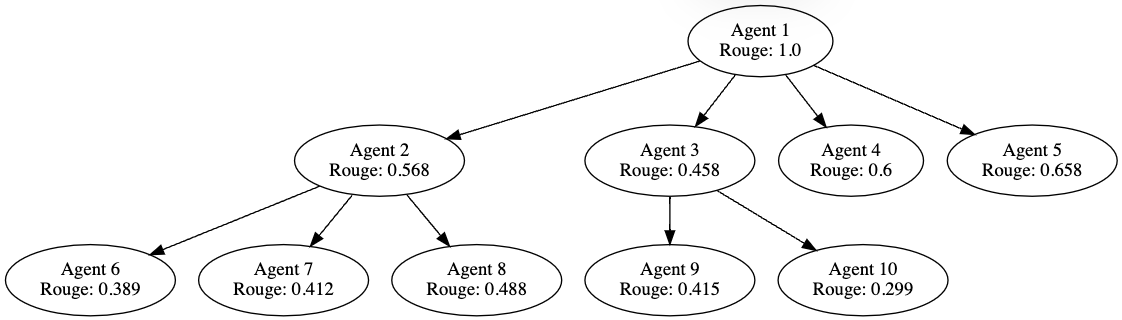
Figure 1. ROUGE-1 scores across agent generations
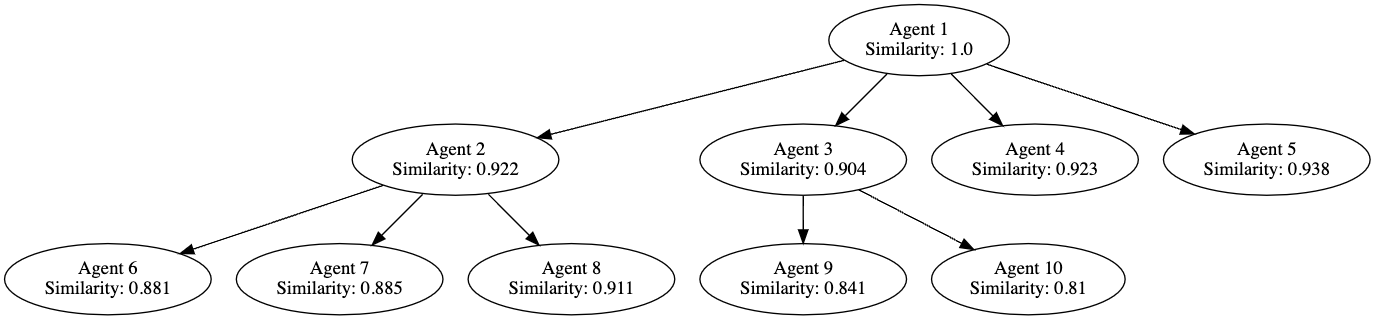
Figure 2. Cosine similarity scores across agent generations
Message Transformation
Our experiment demonstrates how an initially clear instruction becomes
increasingly distorted as it's passed between agents using paraphrasing
LLMs. Original recipe instructions about lime juice preparation evolve
to include non-existent ingredients and procedures by the third
generation of message transmission.
Introduction / Background / Motivation
What did you try to do? What problem did you try to solve? Articulate
your objectives using absolutely no jargon.
Throughout history, human communication demonstrates that information
rarely remains unchanged as it passes from person to person. Stories,
legends, and historical events evolve over time, shaped by biases,
interpretations, and conflicting memories of those who transmit them.
The legend of King Arthur illustrates this phenomenon, as it has been
told and adapted by many authors throughout centuries. We investigate
whether large language models (LLMs) exhibit similar behaviors in
information transmission. Using a simulated "telephone game" experiment
with multiple successors rather than linear chains, we aim to understand
how messages transform as they propagate through a network of AI agents,
similar to information spread in human populations.
How is it done today, and what are the limits of current practice?
While extensive research has explored the behavior of individual LLMs,
studies on their interaction are relatively limited. Existing research
on the telephone game with LLMs primarily focuses on linear chains of
transmission. For example, one study by Perez et al. (2024) tracked how
text properties like toxicity, positivity, difficulty, and length evolve
through iterated interactions between LLMs. Another multilingual study
by Mohamed et al. (2025) demonstrated that distortion increases with
time and complexity but can be mitigated with strategic prompting.
However, these studies are limited to linear chains, which don't
accurately reflect how information spreads in real-world populations or
collaborative multi-agent systems.
Who cares? If you are successful, what difference will it make?
Understanding information transmission between LLMs has critical
implications for collaborative AI systems, particularly in applications
like swarm robotics. Imagine a swarm of robots collaborating on a common
task, where only one robot receives the initial instructions. If each
robot has its own LLM, the message must propagate accurately through the
swarm. Any distortion could cause robots to pursue different objectives,
compromising collaborative efficiency. Our research not only enhances
understanding of LLMs' potential for cumulative cultural evolution and
their vulnerability to biases but also provides key insights for
designing reliable AI communication systems where message integrity is
essential for coordinated action. The findings could inform better agent
communication protocols, more robust information sharing mechanisms, and
improved task delegation in complex AI systems.
Approach
What did you do exactly? How did you solve the problem? Why did you
think it would be successful? Is anything new in your approach?
TODO
To measure information degradation, we applied two key metrics:
-
ROUGE-1 score: comparing word overlap between original and paraphrased
messages
-
Cosine similarity on word embeddings: comparing semantic similarity
despite different wording
What problems did you anticipate? What problems did you encounter?
Did the very first thing you tried work?
TODO
Results
How did you measure success? What experiments were used? What were
the results, both quantitative and qualitative? Did you succeed? Did
you fail? Why?
TODO
We measured information preservation through two metrics: ROUGE-1 scores
(measuring lexical overlap) and cosine similarity (measuring semantic
similarity). Our experiment with a 10-agent tree revealed several key
findings:
| Agent |
Generation |
ROUGE-1 Score |
Cosine Similarity |
| 1 (Root) |
0 |
1.0 |
1.0 |
|
First-level (2-5)
|
1 |
0.45-0.65 |
0.90-0.94 |
|
Second-level (6-10)
|
2 |
0.30-0.49 |
0.81-0.91 |
Table 1. ROUGE-1 scores and cosine similarity measurements across
agent generations
Conclusion and Future Work
TODO